
You know that feeling when you wake up one morning and something just feels off? And You cannot name it exactly. You Google something vague, read three contradicting articles, close the tab, and go about your day. Underneath all of it is a quiet stress that comes from not having a real plan
That feeling is more common than people admit. But it does not have to be normal.
When you have a real approach to adult wellness, that panic starts to fade. Not because nothing ever goes wrong, but because you are no longer starting from zero every time it does.
What Adult Wellness Actually Means for Real People
Nobody sits around thinking about their health when everything feels fine. That is just honest. Life is busy. Work does not slow down. Responsibilities pile up from every direction. So, health gets pushed to the back until something forces it to the front.
Adult wellness is not about being obsessed with your health. It is about being informed enough to notice when something is off and having a place to go where someone actually knows your story.
North McKinney is growing fast. New neighborhoods, new businesses, new everything. Somewhere in the middle of all that settling in, finding real healthcare that fits your life can feel like one more thing on an already long list. This guide is here to make that part easier.
The Search for an Affordable Family Doctor Near Me Is More Important Than It Sounds
Most people type affordable family doctor near me into their phone when they are already stressed about something. A weird symptom. A feeling they cannot quite name but cannot shake either.
The search results are overwhelming. Clinics with names that mean nothing to you. Reviews that all sound polished and a little too perfect.
Here is what actually makes a difference though. When you keep seeing the same doctor over time, the care gets better in ways that are hard to explain until you have experienced it. Your doctor stops being a stranger you see once a year and becomes someone who actually knows you
They remember that you have always run a little anemic and know your blood pressure trends up when work gets heavy. They know you push through things longer than you should.
That kind of knowing is one of the most underrated benefits of having a adult wellness doctor. It is not glamorous. But it is the thing that actually changes your health over time.
How Often Should You See a doctor? Be Honest with Yourself Here
Most people, if they are honest, go to the doctor when something hurts enough to make them go. Not before.
How often should you see a doctor is a question worth sitting with. For most healthy adults, once a year is the baseline. Adults managing chronic conditions or approaching their 50s and 60s, every few months is often the better rhythm. For adults over 65, more frequent check-ins become genuinely important for staying ahead of age-related changes.
The reason for this matters because your body gives quiet signals long before it gives loud ones. If you only show up when the signal is loud, you have already missed a window.
Signs You Need to See a Doctor That Have Nothing to Do With Pain
This one catches people off guard. When we think about signs you need to see a doctor, most of us picture pain, fever, or something obvious. Some of the most important signs are the ones that do not feel urgent at all.
Tired all the time even though you are sleeping. Putting on weight without eating differently. Feeling foggy or flat for weeks. Getting irritated faster than usual. These things are easy to explain away. Busy season at work. Too much on the plate right now. I just need a vacation.
Sometimes that is true. But sometimes your body is trying to tell you something and you keep hitting snooze on it.
If any of this sounds like your last few months, that is a good enough reason to go ahead and schedule annual physical exam appointments instead of waiting for the obvious thing to happen.
What Actually Happens When You Schedule Annual Physical Exam Visits
A lot of people avoid their yearly checkup because in their head it is this big, formal thing. But it really is not.
When you schedule annual physical exam visits every year, your doctor starts building what they call a baseline. Your blood pressure, cholesterol levels, and blood sugar. Nothing dramatic. Just numbers that tell a story over time.
When something shifts in that story, your doctor notices. Not because they are looking for problems, but because they know what your normal looks like.
You also get real time to talk. Not five rushed minutes. Actual time to bring up the thing you have been meaning to mention for three months but kept pushing aside. That part matters more than people think.
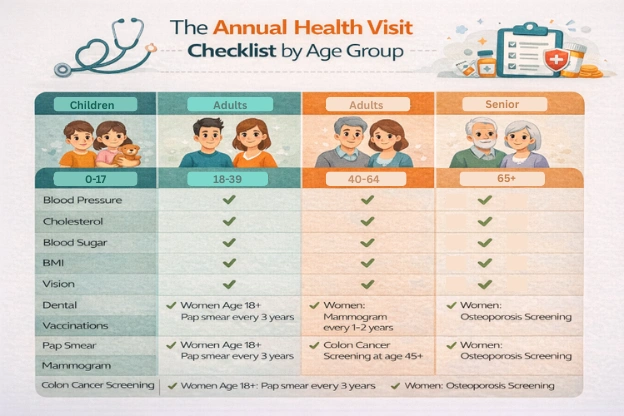
Women’s Health After 40: The Chapter Nobody Really Prepares You For
If you are in your 40s and things feel different in ways that are hard to describe, you are not imagining it. Women’s health after 40 changes in ways that are real, sometimes disorienting, and almost never talked about as openly as they should be.
Your hormones start shifting more noticeably. Sleep feels lighter than it used to be. Weight does things that make no sense given how you are eating. The mood has edges it did not have before. And nobody around you seem to be connecting the dots.
This is not something to just push through. It is something to actually talk to a doctor about, someone who takes the time to understand the full picture of what is happening in your body and your life, not just hand you a referral and send you on your way.
What Happens at a Well Woman Exam and Why It Deserves a Spot on Your Calendar
A lot of women know they should be going but keep putting it off because they are not sure what to expect at a well woman exam or what happens at a well woman exam beyond the basics.
So here is a flow. You come in. Your doctor checks your vitals, does a full physical, performs a pelvic exam, and depending on your age and history, a pap smear and breast exam. They also talk through what screenings make sense for where you are in life. For women over 40, that conversation might include mammograms, bone density, or thyroid levels.
It is not quick once over. It is a real visit where someone looks at the whole picture. And for women in their 40s and beyond, it is honestly one of the most important things you can put on your calendar every single year.
As a trusted primary care physician McKinney families rely on, Peoples Medical Care offers personalized women’s and men’s health programs covering hormonal health evaluations, preventive screenings, and lifestyle guidance built around what men actually need to stay healthy long term.
Behavioral Health vs Mental Health: They Are Different and Both Matter
People use these terms interchangeably, but they are actually not the same thing. Understanding behavioral health vs mental health helps you figure out what kind of support you or someone in your family actually needs.
Mental health is about what is happening emotionally and psychologically; depression, anxiety, and mood shift that affect your daily life.
Behavioral health is a wider lens. It includes mental health but also looks at the habits and patterns that affect how you feel. Sleep. Stress responses. The things you reach for when life gets hard.
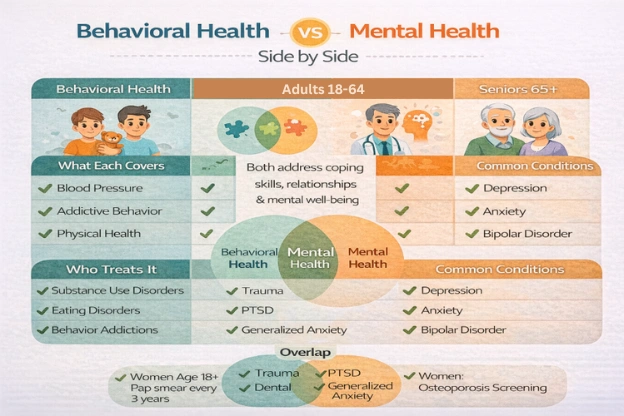
Both matter. Both are real. And having the right word for what you are going through is sometimes all it takes to actually ask for help.
When to See a Mental Health Professional: You Do Not Have to Be in Crisis to Reach Out
There is this idea that you only see a mental health professional when things have gotten really bad. When you cannot function. When everyone around you notices something is wrong.
That is not how it has to work. Knowing when to see a mental health professional is really just about noticing a pattern. Two weeks of feeling low and not knowing why. Relationships that feel harder than they used to. Sleep that is off for no clear physical reason. Reaching for habits that give you relief in the moment but do not actually help.
You do not have to wait for a breaking point. Going early is not dramatic. It is just taking care of yourself the same way you would if something felt off physically.
How Does Mental Health Affect Physical Health
This Connection Is Worth Understanding. How does mental health affect physical health is one of those questions that sounds almost too simple, but the answer is pretty eye opening.
When you carry a lot of stress for a long time, your body runs a kind of background alarm. Cortisol levels stay high. Blood pressure creeps up. Your immune system does not work as well as it should. Sleep quality drops even if the hours look fine on paper.
Untreated depression has a documented link to higher rates of heart disease. Anxiety affects digestion, pain levels, and energy in ways that feel purely physical but are not.
This is why the clinics that treat the whole person, not just the symptoms in front of them, tend to get better outcomes. Your physical health and your emotional health are running on the same system. They cannot really be separated.
What North McKinney Adults Are Really Looking For
It is not complicated when you strip it back. Adults here want a clinic that feels like a relationship, not a revolving door. A team that remembers who you are. A doctor who treats you like a person, not an appointment slot.
That is what real adult wellness looks like in practice. Not perfect health all the time. Just a foundation solid enough to handle the hard moments without everything falling apart.
If you are ready to start, whether that is booking a physical, getting a well woman exam on the calendar, having a first honest conversation about mental health, or simply figuring out where you stand right now, we are here for exactly that.
Book your visit with our North McKinney team today.
Once a year is a good starting point for most healthy adults. That visit lets your doctor check your key numbers, notice anything worth watching, and keep a running picture of how your health is trending over time. Adults managing chronic conditions or over the age of 60 often benefit from more frequent visits throughout the year.
Urgent care is great for the immediate problem. But they do not know your history, and they are not following up next month. A family doctor builds every visit. They connect patterns across time, catch things that might otherwise slip through, and give your whole family a level of personalized care that urgent care simply is not built to provide. Over time, that relationship will be one of your most valuable health assets.
You will get a full physical, a pelvic exam, a pap smear based on your age and history, a breast exam, and a real conversation about screenings that make sense for where you are in life. Most visits run about thirty to forty-five minutes. It is private, comfortable, and genuinely one of the most worthwhile appointments you can make for each year, especially once you are in your 40s.
Chronic stress and untreated anxiety or depression keeps your body in a kind of low-level alert state. Over time that shows up as elevated blood pressure, disrupted sleep, digestive issues, and a weaker immune response. The link between depression and heart disease is well documented. When you take your mental health seriously, your physical health tends to follow in a positive direction too.
Dedicated Doctors Committed to Your Long-Term Health
At Peoples Medical Care McKinney, patients are cared for by dedicated physicians who believe in listening first and treating with purpose. Dr. Zulfarah Ishaque and Dr. Munaza Gohar bring over a decade of combined experience in internal medicine, preventive care, and chronic disease management to every patient they see.
Their approach goes beyond simply treating symptoms. They focus on understanding each patient’s health history, lifestyle, and concerns to create personalized care plans that support long-term wellness. Whether you are visiting for routine checkups, managing ongoing conditions, or addressing new health concerns, their goal is to make you feel heard, supported, and confident in your care.
At Peoples Medical Care McKinney, healthcare is not just about appointments. It is about building lasting relationships and helping patients live healthier, more comfortable lives.